My post on Linkedin last week questioned why, given all the advances in technology and understanding of the value of data over the past 20 years, companies still seem to be hitting some of the same barriers in getting value from Digital Analytics. More specifically, are we any better now at:
- asking the right questions
- communicating the results found
- the interpretation and use of these answers to drive action
Many thanks to everyone who read, liked and especially commented on the post. But I wanted to follow up on one comment, from Andrew Farthing MBCS. He wrote that it “Depends who’s asking the questions – this is where a hybrid of BA & BI skills are worth their weight in gold to act as a translator AND a storyteller.”
This worries me.
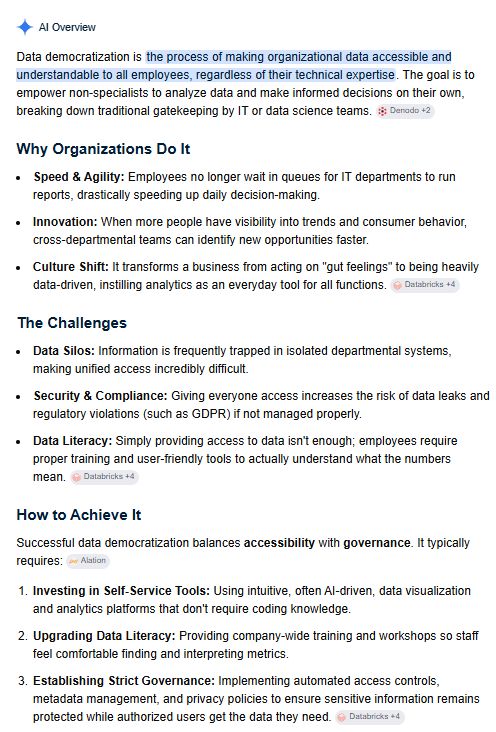
It is, hopefully, common consensus that data democratisation is good thing. A quick search on Google gives the AI answer included in this post – we want everyone able to access and use data, regardless of their natural skill set. Unspoken in that response is the reason that people will make better decisions and take better actions if they combine the insights from data with their own knowledge, skills and experience.
Looking at the “How to achieve it” bullet points, we have the necessary tech available now and the processes for data governance are known, even if implementation is a challenge. But on Data Literacy, it simply says that people need to understand what numbers mean and that they feel comfortable finding and interpreting metrics.
That, to me, is not enough.
As per the comment from Andrew, you still need someone with the right skillset to act as a translator and a storyteller. It is great if everyone can access data, can understand the numbers but that doesn’t mean they are the right numbers to be accessing and understanding. If specific skills are still required to ask the right questions, data has not been democratised, only access to data has been.
With the current approach, we still have gatekeepers and results not matching expectations.
We need data literacy to expand beyond data access and interpreting metrics, for Digital Analytics at least. It needs to be based on the concept that data is just a way of representing people and the real focus must be on understanding people, not on understanding data. Proper data literacy will range from critical thinking and how to ask the right questions through to how to use tools to access data and how what data means.
What about your experiences? Do the data literacy programmes you have been exposed to cover the question asking in addition to understanding the answers & the data? Do you think it is even possible to transfer these skills from the data gatekeepers to everyone in the organisation?
A key question these days, do you find AI is good at asking the right questions?
And if this is something your organisation is missing, feel free to reach out.
This post was originally published on LinkedIn on 27th May 2026. View the original post and discussion here.